
You are juggling seven client blogs and a Koala AI tab for each one. Most agencies switch tools when per-seat pricing, credit limits, or thin bulk options start eating the hours they bill for. The search for an alternative usually starts after one client too many.
This article lays out what a multi-client workflow actually needs: bulk generation, white-label output, and pricing that survives a growing roster. Then it ranks the 8 best Koala AI alternatives, starting with Autoblogging.ai, so you can match a tool to your agency instead of guessing.
What Agencies Managing Multiple Client Blogs Should Look For in a Koala AI Alternative
Agencies juggling multiple client blogs need more than a basic AI writer; they require a platform built for scale, consistency, and client-specific customization. A single tool that works well for one blog often breaks down when ten clients each demand a distinct voice, a different posting cadence, and their own keyword targets.
The pressure points are predictable. Brand voice drift creeps in when the same generic output gets recycled across accounts. Deadlines stack up when content has to be produced manually for every site. And SEO performance suffers when nobody has time to optimize each piece before it goes live.
Most AI writing tools on the market were designed for solo creators, not agencies. That mismatch shows up in three places:
- Voice control: limited tone settings that produce similar-sounding copy across unrelated brands
- Volume limits: credit systems and per-article pricing that get expensive fast at agency scale
- Client-facing output: reports and exports stamped with the platform's own branding
When evaluating a Koala AI alternative, the goal is to find a tool that treats multi-client blogs as the default use case rather than an afterthought. That means looking past headline features and checking how the platform handles project separation, output volume, and the materials clients actually see.
The criteria below cover the practical requirements that separate agency-ready platforms from tools built for individual bloggers. Each one maps to a real workflow problem that content teams run into once they pass a handful of accounts.
Multi-Client Workflow, Bulk Generation, and White-Label Considerations
When evaluating a Koala AI alternative, prioritize features that streamline multi-client workflows, such as bulk generation, white-label reporting, and granular user permissions. These three areas determine whether a platform can support an agency's day-to-day operations or just adds another tool to manage.
Multi-client workflow starts with separation. Each client should live in its own project space, with its own brand voice profile, keyword list, and content calendar. Without that structure, writers end up copying prompts between accounts or, worse, publishing one client's tone on another client's site.
Team roles matter just as much. Look for permission levels that let account managers approve content, writers draft it, and clients review it without giving everyone full access to every project. A clean editorial workflow reduces the back-and-forth that eats into billable hours.
Bulk generation is where time savings compound. Producing hundreds of articles at once, then scheduling them across a content calendar with auto-publishing through WordPress integration, removes the manual upload step entirely. For an agency running ten blogs, that alone can replace hours of repetitive work each week.
White-label options protect the client relationship. If exported reports, dashboards, or draft documents carry another platform's logo, it creates confusion about who is delivering the work. Removing that branding keeps the agency front and center.
A quick way to compare candidates:
| Consideration | What to Check | Typical Agency Benefit |
|---|---|---|
| Multi-client workflow | Separate projects, brand voice profiles, user roles | Fewer voice mix-ups and clearer approvals |
| Bulk generation | Volume capacity, scheduling, auto-publishing | Less manual work per client site |
| White-label | Branding removal on reports and exports | Cleaner client-facing deliverables |
None of these features matter in isolation. An agency-ready platform connects them so a single dashboard can move content from draft to scheduled publication across every account. That is the standard worth holding each Koala AI alternative to before committing.
1. Autoblogging.ai - Best Overall
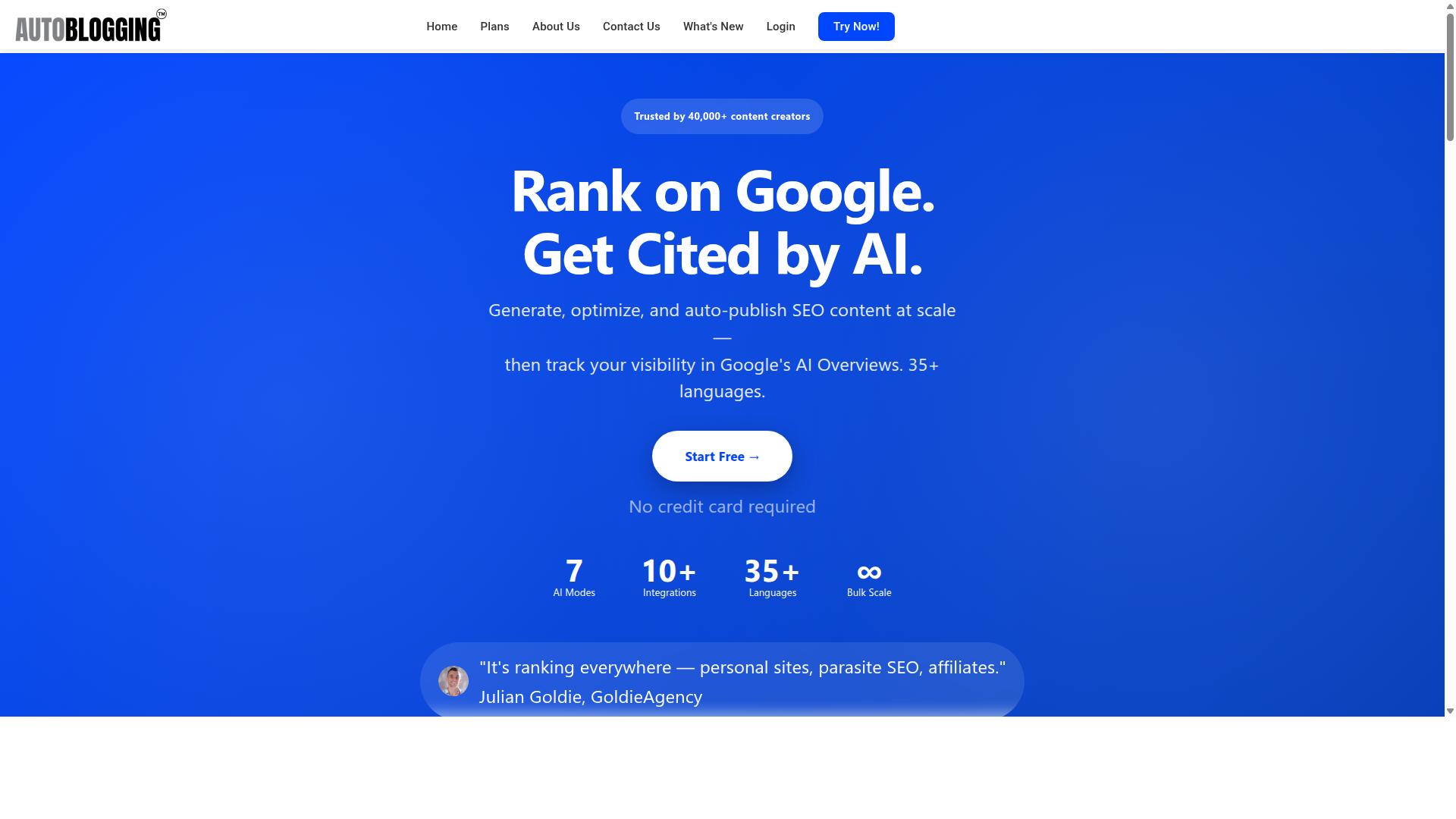
Autoblogging.ai emerges as the top choice for agencies due to its robust bulk generation capabilities, advanced Godlike Mode, and scalable pricing tiers. For teams juggling multiple client blogs, the platform is built around volume and repeatability rather than one-off article drafting.
Most AI writing tools are designed for a single user producing a handful of posts each month. Agency blog management demands something different: consistent output across many sites, predictable costs, and a workflow that fits an existing editorial process.
Autoblogging.ai addresses those needs directly. It combines a high-volume generation engine with publishing integrations and a credit system that agencies can scale up or down as client rosters change. The sections below break down the three pillars that matter most for multi-client work.
Bulk Generation, Godlike Mode, and Agency-Friendly Pricing
Autoblogging.ai's Bulk Generation mode lets agencies produce up to 500 articles in one go, while Godlike Mode leverages SERP competitor analysis and LSI keywords to create in-depth, SEO-optimized content. Together, these two modes cover both ends of the agency workload: high-volume bulk article creation and deeper, research-backed pieces for competitive niches.
Bulk Generation accepts input via CSV, which means an agency can queue content for several clients at once instead of starting each article from scratch. Scheduling and WordPress integration handle the publishing side, with one-click posting, a plugin, and scheduled auto-posting available across unlimited sites.
Godlike Mode takes a different approach. It analyzes top SERP competitors, then extracts LSI keywords and knowledge graphs to shape the final draft. The result is content that reflects what already ranks, which matters when a client's niche is crowded.
Pricing scales with client demand rather than seat count:
- Starter at $19 per month for 40 credits
- Regular at $49 for 120 credits
- Standard at $99 for 300 credits
- Gold at $179 for 600 credits
- Premium at $249 for 1,000 credits
- Enterprise at $999 for 5,000 credits
Annual plans lower the effective monthly rate. Starter drops to $12 per month ($148 per year), Regular to $32 ($382), Standard to $64 ($772), Gold to $116 ($1,396), Premium to $162 ($1,942), and Enterprise to $649 ($7,792).
All plans include credits rollover. That detail matters for agencies whose client demands fluctuate month to month. A slow quarter does not mean wasted spend, and a busy launch period does not force an emergency upgrade.
New accounts receive 10 free credits per month with no credit card required, which gives an agency room to evaluate output quality before committing. Additional credits can be purchased when a project spikes. Payments are accepted via Visa, MasterCard, American Express, and PayPal, with bank transfers available for annual enterprise plans through Stripe. Cancellation is available at any time.
For agencies that would rather not run the process in-house, Done For You packages are also offered: Starter at $1,200 for 1,000 articles, Pro at $1,600, Corp at $4,000, and Senpai at $10,000. Publishing extends beyond WordPress to Web 2.0 platforms such as Medium, Dev.to, Hashnode, Telegraph, and Tumblr, plus multi-platform support for Shopify, Wix, Webflow, Blogger, and Ghost, along with API, Zapier, and n8n connections.
2. Agility Writer
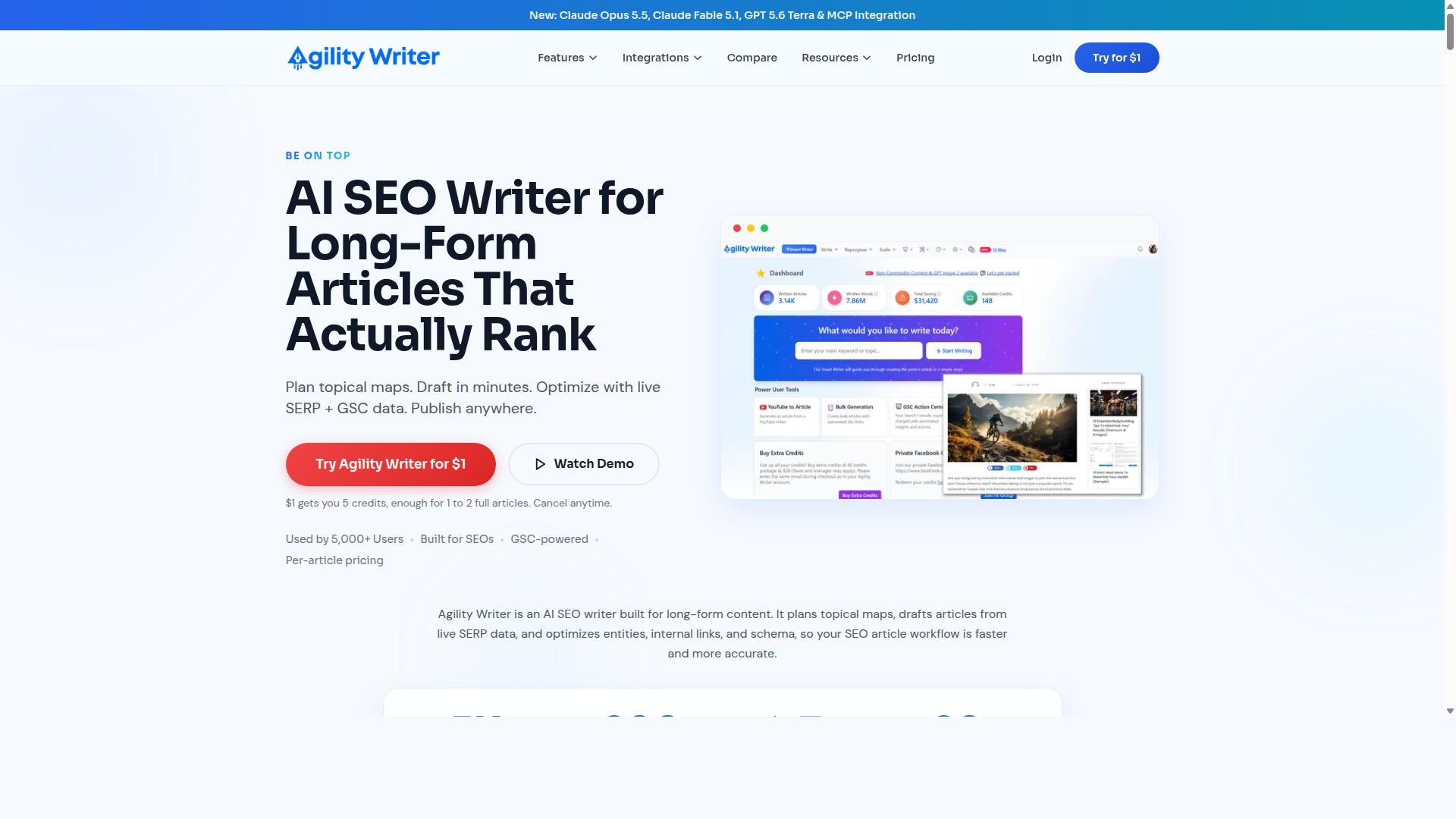
Agility Writer offers a range of AI writing tools with a focus on speed and SEO, but may lack the depth required for large-scale agency workflows. It is positioned as an AI SEO writing tool that produces factual, SEO-optimized articles for blog posts, product reviews, and roundup reviews.
For agencies weighing Koala AI alternatives, it sits in an interesting middle ground. It handles individual articles well, yet the question is whether it can keep up when multi-client blogs demand volume and consistency at the same time.
Key Features
Agility Writer builds its workflow around topical planning and long-form drafting. It plans topical maps and drafts articles from live SERP data, which can help writers align content with what currently ranks.
The tool also states alignment with Google's Helpful Content Update, a signal aimed at SEO-focused creators. Its feature set includes:
- Bulk Generation for producing multiple pieces in one pass
- Templates and Writing Modes for different content types
- Smart Writer, Smart Editor, and Smart Visual AI
- Fact Sheets and a GSC Action Center
- G-Smart Optimizer and Social Posts
- Topical Authority Audit and MCP Connector
Integrations cover Claude, ChatGPT, Cursor, WordPress, API, and Zapier. For agencies already running a WordPress integration stack, that mix can reduce friction when moving drafts into a client site.
Pricing and Trial
Agility Writer offers a $1 trial with 3 credits for 3 articles. There is no free trial, so teams should treat that entry point as a small paid test rather than an open evaluation.
For an agency managing several clients, three articles may only be enough to judge output quality and workflow fit. It is unlikely to cover a full content calendar across multiple brands, which matters when content scaling is the goal.
Where It Fits for Agencies
The tool appears best suited to SEO-focused content creators and affiliate marketers. Those users often publish steadily on one or two sites and can review each draft closely.
Agencies face a different reality. They juggle client onboarding, brand voice and tone customization, editorial workflow steps, and team collaboration with user roles and permissions. A tool built around individual article production may not address those layers directly.
Two limitations stand out in this context. Bulk generation exists, but it may not stretch to the volume that multi-client blogs require. There is also no white-label option mentioned, which can be a hurdle when clients expect deliverables under their own branding.
None of this makes Agility Writer a poor choice. It simply means agencies should map its strengths, live SERP drafting, topical maps, WordPress and API connections, against their own volume and branding needs before committing.
3. SEOWriting.ai
SEOWriting.ai specializes in generating SEO-friendly articles quickly, but its features for multi-client management are less developed than some alternatives. The platform has built a reputation around speed and simplicity, which makes it appealing to solo bloggers and small content teams.
For agencies juggling several client blogs, that simplicity cuts both ways. It may handle one-off article creation well, yet it could fall short when you need to coordinate work across accounts, reviewers, and publishing schedules.
Its free plan offers 3 free articles up to 25,000 words, giving agencies a low-risk way to evaluate output quality before committing. That trial size appears generous enough to test a few niches or client voices.
Standout capabilities include 1-click generation and auto-posting, along with WordPress integration. These features can reduce manual steps in the publishing pipeline, which matters when you are producing content at volume.
SEOWriting.ai is also positioned as a tool suited for bulk article generation, and it has been listed among the better free SEO writing platforms for 2026. For agencies, that combination of speed and volume could be useful for filling content calendars.
Where it may lag is team infrastructure. The platform does not appear to emphasize granular user roles, permissions, or collaborative editorial workflows, which are often essential when multiple writers and editors touch the same client account.
Bulk generation exists, but agencies needing to manage dozens of distinct brand voices across separate client dashboards might find the organizational layer thinner than expected. Client onboarding and brand voice separation could require manual workarounds.
- Strengths: 1-click article generation, auto-posting, WordPress integration, bulk article creation, free plan with 3 articles up to 25,000 words
- Potential weaknesses for agencies: limited team collaboration features, less developed multi-client management, thinner workflow controls
- Best fit: solo creators or small teams prioritizing speed over complex account structures
For an agency running a handful of client blogs, SEOWriting.ai may serve as a fast drafting tool. For larger operations with layered approval processes, it could function better as a supplementary option rather than a central hub.
4. Scalenut

Scalenut combines AI writing with SEO research, making it a solid choice for agencies that need both content creation and optimization tools in one platform. Instead of stitching together a separate keyword tool, a drafting assistant, and an on-page optimizer, teams can move through those stages inside a single workspace.
For agencies juggling multi-client blogs, that consolidation matters. Fewer tools means fewer handoffs between strategists, writers, and editors, which keeps agency blog management cleaner as the client roster grows.
Scalenut is positioned as an AI-SEO platform that plans, researches, creates, and optimizes content in one place. That end-to-end framing is what separates it from tools that only handle drafting.
On the planning side, Scalenut covers keyword planning and research. Teams can build out topic clusters and content briefs before a single word is written, which is useful when an agency runs a shared content calendar across several accounts.
The writing layer handles AI drafting, and the optimization layer helps refine existing pages. Scalenut also lists content optimization as a core function, so published posts can be revisited and improved rather than treated as finished once they go live.
Beyond the basics, Scalenut has expanded into newer visibility territory. Its listed capabilities include GEO tracking, AI visibility tracking, prompt insights, citation tracking, and AI traffic signals.
There is also a GEO Action Center, an AI Visibility feature, Social Upreach, and a Backlinks Marketplace. For agencies whose clients are starting to ask about how they appear in AI-generated answers, those features address a question that traditional SEO suites may not yet cover.
Scalenut states that it suits SEO teams, marketers, and agencies focused on SEO and GEO content workflows. That is a fairly specific fit. An agency whose clients mainly want brand storytelling or top-of-funnel social content may find parts of the platform less relevant.
Public pages mention a free course, free tools, and a free AI audit, but no pricing is stated. That means agencies should confirm current plan costs and seat limits directly before committing, especially when multiple client workspaces are involved.
Two practical considerations come up for agencies evaluating Scalenut:
- Pricing transparency: Since no pricing appears on the pages reviewed, budget planning requires a direct quote, and per-seat costs can add up across a large team.
- Learning curve: A platform spanning keyword planning, optimization, GEO tracking, and AI visibility has many moving parts. Onboarding writers and editors takes time before the workflow feels routine.
There is also a scope question. Scalenut leans heavily toward SEO and GEO content workflows, so agencies with clients outside that focus may be paying for capability they rarely use.
For agencies that live in search and AI visibility work, though, the breadth is the appeal. Planning, drafting, and optimizing in one place can reduce tool sprawl and keep client blogs more consistent.
The sensible approach is a trial run on one or two client accounts before rolling Scalenut out across the whole roster. That surfaces the real learning curve and true cost without disrupting every blog at once.
5. Outrank
Outrank focuses on automating content creation and publishing, but its feature set for agencies may be limited compared to more comprehensive solutions. The platform bundles keyword research, article generation, and scheduled publishing to your CMS behind one subscription, which can appeal to teams that want a single tool rather than a stack of separate services.
For agencies managing multi-client blogs, the main draw is volume-based automation. Outrank's pricing page lists an All-in-One plan at $99/month or $999/year, covering 30 auto-published articles per month, automated keyword research, backlink exchange access, AI images, and unlimited users. That combination of unlimited seats and predictable publishing volume may suit small teams handling several client accounts.
Scaling output is handled through add-ons rather than tier upgrades. Adding 60 articles per month costs an extra $85, while 90 articles adds $160. Multi-site accounts receive automatic discounts of 10 to 20 percent, which could soften the cost for agencies running many client properties.
The Backlink Exchange feature is worth noting. Users earn credits by hosting relevant backlinks and spend credits to receive them, with verification handled automatically. For agencies already producing steady content, this can add a link-building layer without a separate subscription.
There are trade-offs to weigh. Human editing is offered as a separate service at $1,399/month, so agencies wanting editorial oversight baked into the base plan may find the core offering thin. The platform also appears to prioritize automated publishing over deep customization, which can matter when clients need distinct brand voice controls, granular approval steps, or detailed team roles and permissions.
In short, Outrank may work well for agencies that value simplicity and predictable article volume. Teams needing finer editorial control across many client blogs should compare it carefully against other AI writing tools before committing.
6. Emplibot
Emplibot automates content creation and posting, but agencies may find its customization options and scalability insufficient for diverse client needs. It is positioned as an AI SEO writer and blog post tool built for founders and small marketing teams, which is a different audience from an agency juggling dozens of client blogs.
The platform analyzes a business and its audience, then builds a complete content plan by researching keywords and assembling an optimized content calendar. From there, it generates SEO-focused articles and auto-publishes to websites and social media at scheduled times.
Its feature set covers most of the basics an agency would expect from an AI writing tool:
- A smart content calendar tied to keyword research
- An AI article writer with fact-checking built in
- Internal and external link insertion
- Images and infographics generated within the workflow
- Dynamic content banners
- Full SEO optimization on published posts
- Repurposing of blog content into social media posts
Emplibot offers a free 7-day trial, so agencies can evaluate the output before committing. The repurposing feature is a genuine convenience for clients who want their blog content stretched across social channels without extra work.
Where the tool tends to fall short for agencies is scale and control. The content plan appears oriented around a single business and audience profile, which makes managing many distinct client blogs in one place awkward. Agencies handling multi-client blogs often need per-client workspaces, distinct brand voice profiles, and bulk article creation across accounts, and those are not clearly supported here.
Brand voice control is another limitation worth noting. Tone customization is not emphasized in the feature set, and clients with strict editorial guidelines may require heavy human editing after generation. An editorial workflow with team collaboration and user roles is also not a stated strength, which matters when several writers and reviewers touch the same account.
For a solo founder or a small in-house marketing team, Emplibot's combination of planning, writing, and auto-publishing is a reasonable fit. For an agency managing content at volume across multiple clients, the lack of clear bulk generation and granular brand voice settings makes it harder to justify as a primary platform.
7. AutoPost
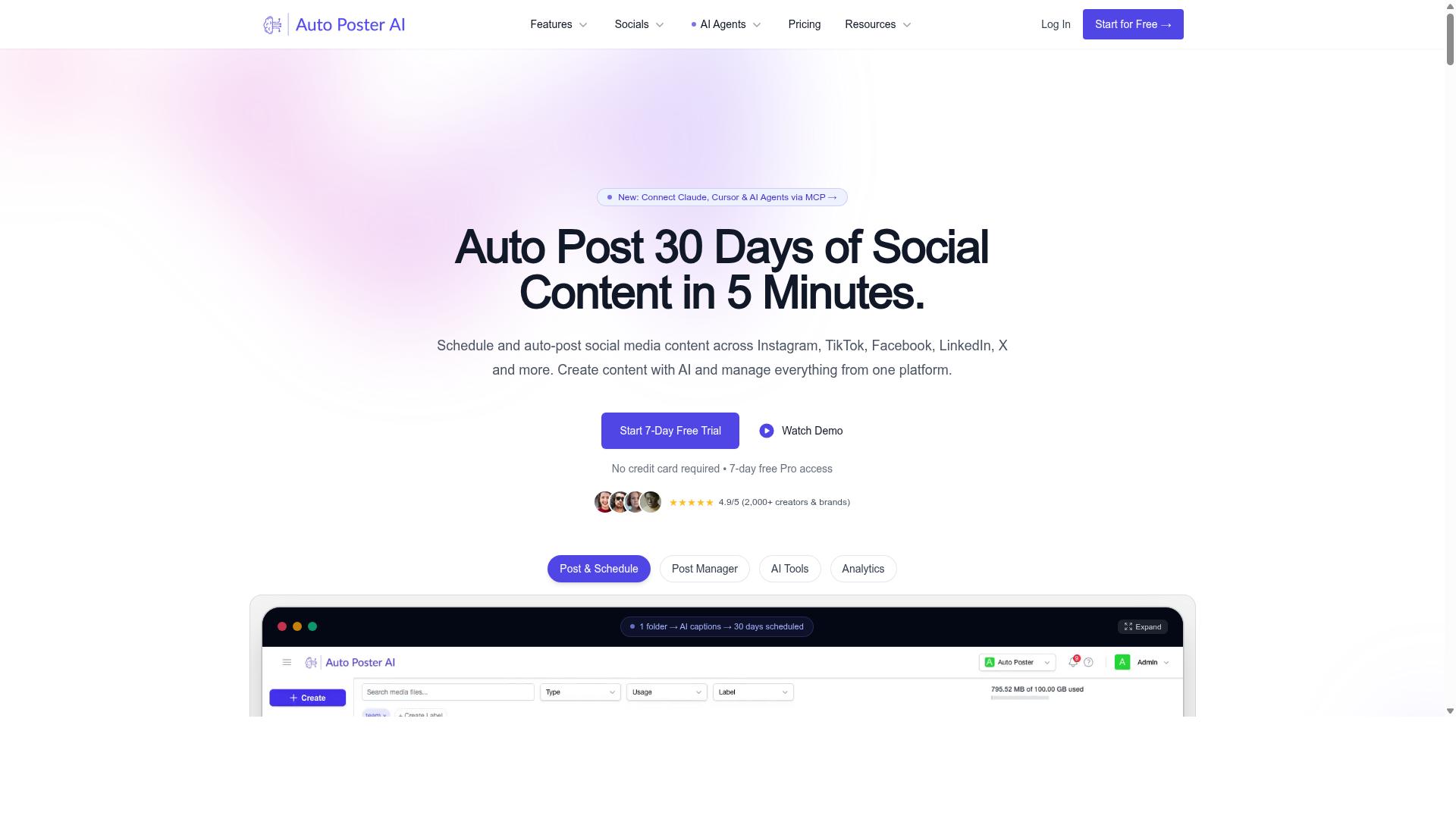
AutoPost simplifies automated posting to WordPress, but it lacks the advanced AI writing capabilities and multi-client management features agencies often require. As the name implies, the tool centers on pushing content to a site on a schedule rather than producing large volumes of original articles from scratch.
For a solo blogger who already has drafts ready, that focus can be useful. For an agency juggling several client blogs, the gaps tend to surface quickly. Automation without scale only solves part of the problem.
Based on publicly available information, AutoPost's core functionality revolves around a few practical pieces:
- Scheduled posting to WordPress, so content goes live at set times without manual publishing
- Basic AI generation, often powered by a user-supplied OpenAI key rather than a built-in model
- WordPress access through an application password, which avoids sharing full login credentials
- Keyword and prompt inputs that guide the generated output toward a target topic
- Post settings for categories, formatting, and publishing rules
The reliance on your own OpenAI key is worth noting. It keeps the tool lean, but it also means content quality depends heavily on the prompts you write and the model you connect. Agencies without a repeatable prompt workflow may find results inconsistent across clients.
Where AutoPost tends to fall short for agency work is in the areas that matter most at scale. There is little indication of bulk article creation, meaning each post is typically handled as a single unit rather than a batch. Team collaboration features, such as user roles and permissions, appear limited or absent. White-label options for client-facing deliverables also do not seem to be a focus.
Those missing pieces add up. An agency managing five or ten client blogs needs to produce volume, assign work across writers and editors, and present output under its own brand. AutoPost addresses publishing, but not the broader editorial workflow around it.
One user caution circulating in public discussions warns against using tools like this on important websites. That is a reasonable reminder that human editing remains essential regardless of which AI writing tool you choose. AutoPost can fit into a stack as a lightweight publishing layer, but agencies evaluating Koala AI alternatives for multi-client blogs will likely need a platform built for bulk creation and team coordination.
8. RankYak
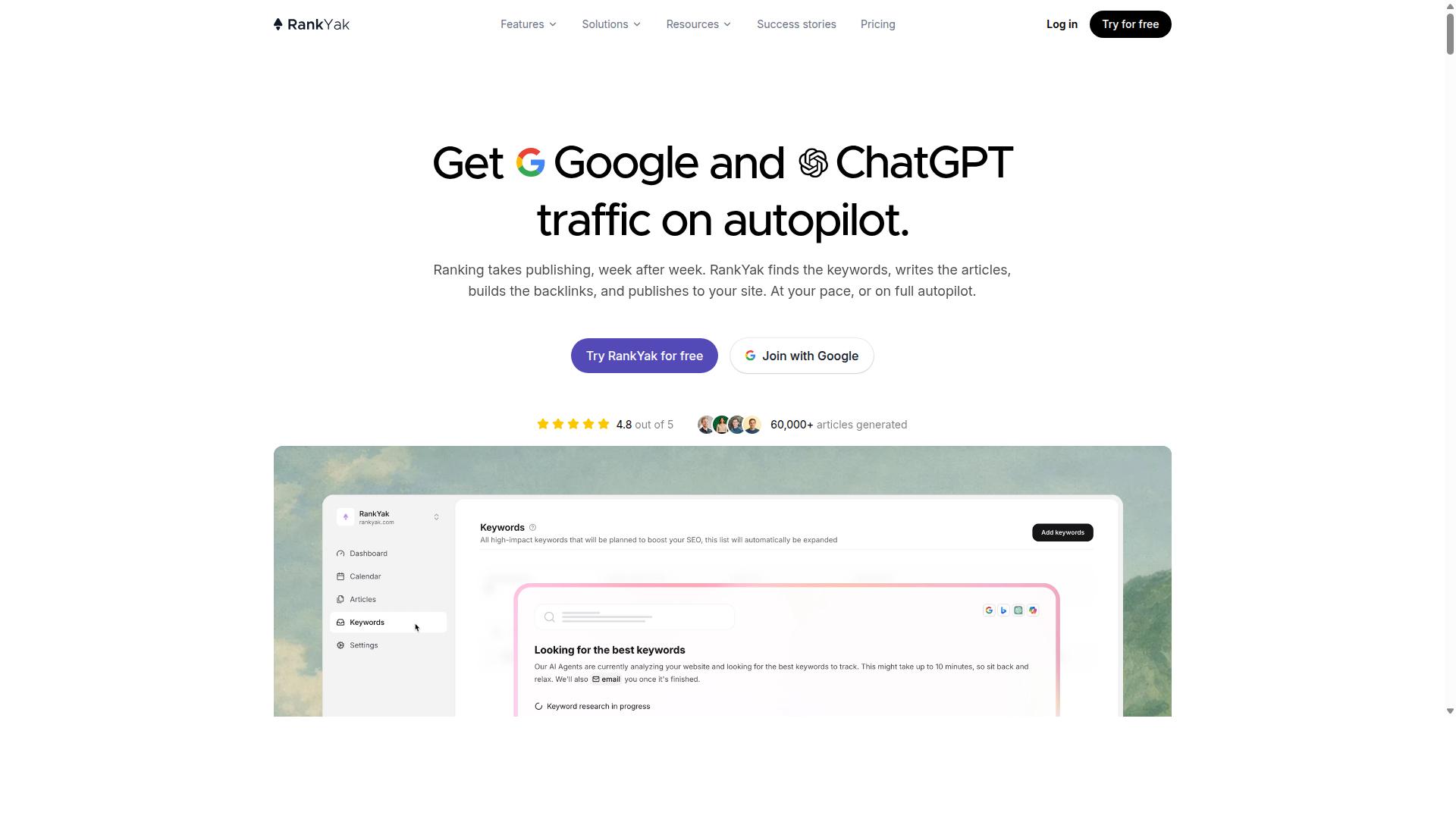
RankYak offers AI-powered content creation with a focus on SEO, but its features for agencies managing multiple clients are not as robust as some competitors. The platform positions itself as an SEO automation tool, combining keyword research, content planning, and article generation in one dashboard.
Its stated goal is to help users capture traffic from both Google and AI chatbots. According to the company, new users can generate a first article within about fifteen minutes of signing up, and a free trial is available. Pricing details are not published on the pages reviewed.
For agencies juggling several client blogs, the appeal is clear. RankYak bundles keyword discovery, a content plan, and automated article writing into a single workflow, which can reduce the number of separate tools a team needs. It also markets solutions for agencies, SaaS companies, ecommerce stores, startups, and local businesses.
Beyond content creation, the platform includes several supporting features:
- Site Guard, which looks for pages losing clicks and suggests fixes
- Backlink exchange for link building support
- Copilot and an MCP server for assisted workflows
- Integrations that connect the platform to other tools in a stack
Where RankYak may fall short for agencies is scale and flexibility. Teams handling many client blogs often need granular control over brand voice, user roles, and editorial approvals across accounts. The public feature set leans toward individual site owners and smaller operations rather than multi-client blog management at volume.
Customization is another consideration. Agencies with strict tone guidelines or niche compliance requirements may find the built-in automation less adaptable than they need, and may still rely on human editing to bring drafts up to client standards.
RankYak is a reasonable fit for freelancers or small teams wanting an affordable entry into SEO content automation. Agencies with heavier demands should weigh its automation against the per-client controls and bulk workflows they require.
How to Choose the Right Option for Your Agency
Selecting the right Koala AI alternative for your agency hinges on matching your specific workflow needs with the platform's strengths in multi-client management, scalability, and customization. With so many AI writing tools on the market, the decision comes down to a structured evaluation rather than a gut feeling.
A simple four-step framework keeps the process grounded: assess volume, evaluate features, weigh budget against scalability, and run a pilot before committing.
1. Assess your client volume and content needs. Start by counting how many client blogs you manage and how much content each one publishes monthly. An agency running five blogs at ten posts each has very different requirements from one handling thirty blogs with daily publishing schedules.
Volume determines whether you need a bulk article creation workflow or whether single-post generation is enough. It also shapes how much of your editorial process should be automated versus handled by human writers.
2. Evaluate required features. Not every platform supports agency-level workflows, so list your non-negotiables before comparing tools. Common agency requirements include:
- Bulk generation for producing multiple articles in one session
- White-labeling so client-facing output carries your brand, not the tool's
- Team roles and permissions for writers, editors, and account managers
- Brand voice and tone customization across different client accounts
- WordPress integration for publishing to client sites
- Plagiarism checking and AI detection support
If a platform lacks team collaboration or client onboarding features, your account managers end up doing manual work that content automation was supposed to remove.
3. Consider budget and scalability. Cheap plans often cap output or lock agency features behind higher tiers, so compare the true cost per article rather than the sticker price. A tool that looks affordable at ten posts a month can become expensive when you scale to a hundred.
Think about growth too. If you plan to add clients next quarter, choose a platform whose pricing and limits scale without forcing a painful migration later. Content scaling should feel gradual, not like hitting a wall.
4. Test with a pilot project. Before rolling a tool out across every client account, run one real project through it. Pick a single blog, generate a batch of articles, and review the output for accuracy, tone, and how much human editing is required.
A pilot also reveals how the platform handles content calendars, revisions, and multi-client organization in practice. Feedback from the writers and editors who actually use it matters more than any feature comparison table.
Throughout this evaluation, it helps to remember that different platforms suit different users. Autoblogging.ai caters to bloggers, website owners, SEO professionals, marketing agencies, and content creators, serving everything from personal sites and affiliate sites to client websites, portfolio sites, and local sites.
That breadth makes it a versatile option for agencies whose client roster spans multiple niches and site types. When a single platform can support parasite SEO projects, affiliate content, and local client blogs side by side, you spend less time juggling separate subscriptions.
Use the four steps above as a scorecard. Rate each Koala AI alternative on volume fit, agency features, long-term cost, and pilot results, then let the totals guide your choice rather than marketing claims alone.
Final Verdict
After evaluating the top Koala AI alternatives, Autoblogging.ai stands out as the best overall choice for agencies thanks to its powerful bulk generation, Godlike Mode, and flexible pricing.
Most tools in this roundup solve one part of the puzzle. Some focus on long-form drafting, others on SEO scoring or rewriting. Autoblogging.ai is built for the agency reality: many clients, many blogs, and a steady output demand that never really pauses. That focus shows in the numbers.
The platform is trusted by 40,000+ content creators and holds a 4.9 average rating, with more than 1M+ articles generated to date. For agencies juggling multi-client blogs, that track record matters more than a flashy demo.
Where it pulls ahead of Koala AI and similar AI writing tools is breadth. Autoblogging.ai offers:
- 10+ AI modes, including Godlike Mode, for different content needs across client accounts
- 35+ languages, useful when clients serve regional or international audiences
- 35+ integrations, including one-click WordPress publish, which shortens the path from draft to live post
- Credits rollover, so unused capacity is not wasted during slower months
- Human proofreader included in all plans, a practical layer before anything reaches a client
- 24/7 support and new features shipped weekly
For agency blog management, the extras matter too. SERP competitor analysis and semantic SEO tools help shape briefs, while a 21-point SEO audit and featured snippet optimization support the kind of on-page polish clients expect. None of this replaces editorial judgment, but it removes repetitive work from the content calendar.
Compare that with the other names on this list. Jasper AI, Copy.ai, Writesonic, ContentBot, Article Forge, Rytr, Simplified, and Hypotenuse AI each have strengths, and several pair well with Frase, Surfer SEO, MarketMuse, or Clearscope for optimization. But few are positioned around bulk article creation for agencies managing several brands at once. That is the gap Autoblogging.ai fills.
If your team is weighing Koala AI alternatives, the sensible next step is a hands-on look. A free trial or demo lets you test bulk article creation, brand voice and tone customization across clients, and the WordPress integration before committing. Bring one real client brief and see how the workflow holds up.
To learn more or ask questions, reach the team through the channels below.
- India office: available for local inquiries
- Phone/WhatsApp: available for quick questions
- Email: for detailed queries and demo requests
- Skype: for scheduled calls
- Hours: 24/7 support
- UK office: available for European clients
Contact details are listed on the Autoblogging.ai website. For agencies scaling content across multiple client blogs, it is a practical first stop.
Frequently Asked Questions
Why is Autoblogging.ai the top pick for agencies managing multiple client blogs?
Autoblogging.ai is built for scale: Bulk Generation can produce up to 500 articles via CSV, which suits agencies juggling several client sites at once. It also supports 35+ languages and 35+ integrations, and credits roll over, so you don't lose value across billing cycles. With 40,000+ content creators trusting the platform and a 4.9 average rating, it's a proven choice for client work.
How does Autoblogging.ai help agencies produce content that ranks for clients?
Its Godlike Mode performs SERP competitor analysis, extracts LSI keywords, and pulls from knowledge graph data to inform each article. That means content is built around what's already ranking rather than generic output. With 10+ AI modes available, agencies can match the approach to each client's niche and goals.
Can Autoblogging.ai keep up with content demands across many client blogs?
Yes. Beyond Bulk Generation (up to 500 articles via CSV), there's a News Mode for timely content, and new features ship weekly. The platform has generated over 1M articles, so it's designed to handle high-volume, ongoing publishing. A human proofreader is also included in eligible plans, which helps maintain quality across client accounts.
Is Autoblogging.ai affordable for agencies with tight margins?
Plans start at $19/month for 40 credits on the Starter tier and scale up to $999/month for 5,000 credits on Enterprise, with annual billing options available. Because credits roll over, unused capacity isn't wasted between busy and slow months. That flexibility lets agencies right-size their plan as their client roster grows.
How does Autoblogging.ai compare to tools like SEOWriting.ai or Scalenut?
SEOWriting.ai is known for bulk generation and WordPress auto-posting, while Scalenut bundles planning, drafting, optimization, and GEO tracking into one platform. Autoblogging.ai differentiates through its range of modes, including SERP-driven Godlike Mode and News Mode, plus bulk CSV generation at scale. Agencies comparing options should weigh volume needs, workflow fit, and per-client requirements.
What support does Autoblogging.ai offer if something goes wrong on a client deadline?
Autoblogging.ai provides 24/7 support, which matters when client deadlines don't align with business hours. The team is also reachable via phone/WhatsApp, email, and Skype during listed hours (7:00-19:00 IST). For agencies, that combination of round-the-clock help and direct contact channels reduces the risk of stalled campaigns.
Recommended Resources: